
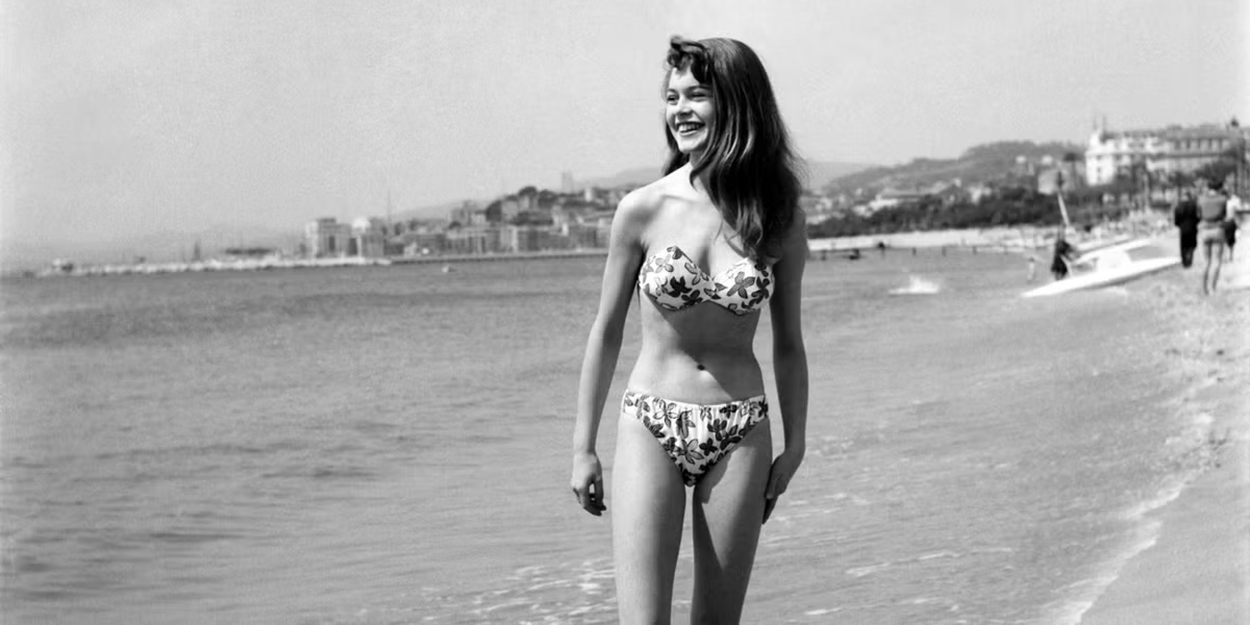
Brigitte Bardot, the bikini that revolutionised fashion: an icon was born in Cannes
In the summer of 1953, an eighteen-year-old Brigitte Bardot transformed a simple swimsuit into a symbol of freedom, helping to forever change the relationship between fashion, society and femininity. On the beach along the Croisette, during the Cannes Film Festival, the French actress appeared before photographers wearing a floral bikini that left her navel exposed: an ordinary sight today, but considered scandalous at the time. The images quickly travelled around the world, establishing Bardot as a new style icon and turning the bikini into a mass phenomenon.
The bikini had been invented seven years earlier, in the summer of 1946.
Its invention is still disputed between designer Jacques Heim and engineer Louis Réard, who patented the garment and named it “bikini”, inspired by the Pacific atoll where the United States was conducting nuclear tests. The aim was to evoke the “explosive” impact the swimsuit would have on public opinion. In post-war Europe, the desire to tan and show more of the body was slowly spreading, but the two-piece swimsuit was still considered far too daring.
Acceptance of the bikini was anything but immediate. In the United States, the Hays Code prohibited the navel from being shown on the big screen; Pope Pius XII condemned the bikini as immoral, while countries such as Italy, Spain, Belgium and Portugal restricted or banned its use on public beaches. Against this backdrop, Brigitte Bardot’s appearance on the beach in Cannes represented a genuine break with the conventions of the time.
The move was no coincidence. Bardot was promoting the film Manina, the Girl in the Bikini (Manina, la fille sans voiles), in which she played a young woman who wore a bikini. The production organised a series of photo shoots on the beaches of the French Riviera, and the one in Cannes became the most famous. Contemporary accounts describe curious onlookers and sailors gathering along the seafront to watch the young actress, while the photographs fuelled an intense international debate between those who saw the bikini as a provocative statement and those who regarded it as a symbol of a new form of female emancipation.
The cultural impact was enormous. The legendary Vogue editor Diana Vreeland reportedly described the bikini as “the most important thing since the atom bomb”, highlighting just how profoundly this tiny garment had changed perceptions of the female body and swimwear. Thanks in part to Bardot’s popularity, the bikini gradually became an everyday garment during the 1950s and 1960s, accompanying the changing social landscape and the emergence of a new idea of sensuality.
In the years that followed, other major stars, including Sophia Loren and Anita Ekberg, followed the French actress’s example by being photographed in bikinis during the Cannes Film Festival, turning the Croisette into an informal runway for summer fashion. Bardot also helped define the aesthetic of the French Riviera, with bare shoulders, gingham dresses, voluminous hair and a natural elegance that continues to inspire fashion designers today.
More than seventy years later, the bikini that caused such a scandal in 1953 looks almost demure compared with contemporary swimwear. Yet Brigitte Bardot’s appearance remains one of the most significant moments in fashion history: an image destined to become part of the collective imagination, capable of transforming a controversial garment into a universal symbol of freedom, modernity, style and female emancipation.
